
Spritual travels in Mexico – an unexpected initiation
I’m not really sure where it came from or why. I was in Peru, had plans to go to Ireland in about 6 weeks, and I was going to head to the jungle but something stopped me. A friend of mine mentioned a trip to Mexico she’d taken and mentioned ‘Oaxaca’ and a bell went off. Her assistant was also from Mexico and something about that felt important. Out of nowhere I was really inspired by the place and felt like I had to go. My energy body is very active and I often feel like some kind of cosmic circuit board that needs to be in a certain place at a certain time for whatever reason. It benefits me by opening things up, and I'm meant to be a cog in the machine as part of a much larger picture. I don’t even question it much anymore, I just show up and do the things.
So over the next few days I looked at flights, spoke to the Mexican assistant, and a plan of what I was meant to do started to formulate. Fly into Mexico City, then travel through a bunch of cities and sacred sites to catch my flight to Ireland from Cancun. I had 5 weeks and Mexico’s a big country so it was ambitious and much quicker than I usually like to travel, but it was doable and it felt right so I was off.
Tepoztlán
My first stop was Tepoztlán, two hours south of Mexico City. A hilltop town with a reputation as one of the country's most 'energetically powerful' places — Temazcal ceremonies, sound baths, the whole scene.
I spent the first night there but wasn’t feeling it. Another place filled with crystal shops didn’t feel like where I needed to stick around for very long, but I got a taxi to Amatlán de Quetzalcóatl, a small village just 15–20 minutes from Tepoztlán as it’s the place most directly tied to the "energy" reputation of the area. It's considered the birthplace of Quetzalcóatl (the Feathered Serpent god or just a human impersonator depending on who you speak to). Regardless, for over 1,000 years, Indigenous pilgrims have trekked these mountains to the site for spiritual transformation — energetic cleansing, chanting, and ritual.
It has the Poza de Quetzalcóatl – a crystal-clear sacred pool where the god is said to have been baptized, and a few other sites. I was drawn to La Tepexinola – "Hill of Women" or "Hill of Fertility," associated with feminine energy and conception. A guide let me through the woodland along a cloaked serpent path to a tiny hidden spring where their version of the Virgin attended a local shrine. I sat and prayed and received the tenderness of her blessings. That part of the trip felt gently done.
Teotihuacan
Next stop was Teotihuacan, the renowned City of the Gods. I hacked my way across Mexico City and booked a hotel near the site so I could get in early. I was filled with an unusual sense of anticipation and also, I was running into a string of things going wrong. Getting there was a mess I’ll spare you the details of. I dropped my phone on the hard floor tiles in the morning and smashed it. I lost my new eagle claw necklace as soon as I got there (I hadn’t earned it yet apparently and it was meant to ‘pay’ something energetically at the site), and when I hopped on my guide’s scooter to go and see the caves, I tore my clothes. I know I have some past lives in that part of the world and that the practices we did in those days weren’t always clean. I’d been given a heads up part of my trip would be to help realign those energies. So I took it on the chin and hoped no further problems were waiting for me.
I connected with the esoteric layers of the place which are worth researching. But mostly I remembered. I remembered what it felt like to be there. Vaguely, but enough. I remembered how I’d seen the place in a schoolbook when I was very young and knew I had to get back there sometime. As I sat on the Pyramid of the Moon in a quieter spot away from the tourists, I felt the privilege of getting to be there again and the sense of what those times were like.
Cholula
I traipsed across Mexico City once again to the southwestern town of Puebla, which hosts the biggest pyramid in the world by volume. The pyramid was dedicated to Quetzalcóatl and served as the premier pilgrimage destination in Mesoamerica.
This is impressive for sure, but when you’re there it just looks like a big hill with a church on top. So much of what was sacred was coopted by the Church. Still, going up there was profound. It did something. I felt how the energies are still very much alive, connected to the cosmos and actively plugged in. I’ve also since heard anecdotally about the very unusual forms of Christian practices held by that church that still leverage technologies more ancient. I meditated and let the alignments do their work.
Oaxaca
Next up: Oaxaca. The bus ride from Puebla was quite long but interesting as we left the lush, red-cliffed landscape of the valley and crossed the desert. Some misty mountain stretches hinted at another trip I’d like to take some time to Maria Sabina’s town of Huautla de Jiménez buried deep along a very windy road but that wasn’t for now. Instead, I enjoyed passing through the cactus forests until we reached the city. I’d planned a 6 day stop in Oaxaca as the travelling so far had been really intense so was looking forward to a break but I had to deal with the realities of my financial situation. Mexico is not India, it’s not even Peru, and hotels are double what I’d been paying elsewhere. These places are noisy and the cheaper places are harder to rest in and my nervous system was taxed. I don’t care much for cities so I’m not going to bother going into their markets or the mole. Anyway, I did get to explore some great sites while I was there, namely:
Mitla
This powerful, intimate site in Nahuatl means 'place of the dead' and was the famous central hub and portal as the gateway between the living and the dead. A legend held that a specific chamber at Mitla was used for the final initiation of shamans trained in magic and healing — making the site a temple of transformation, not just a necropolis. It was built inward — enclosed courtyards, subterranean tombs, no towering pyramids. The barrier between worlds was meant to be thinnest here. I sat with the sonorous resonance of the place and received initiation.
Monte Albán
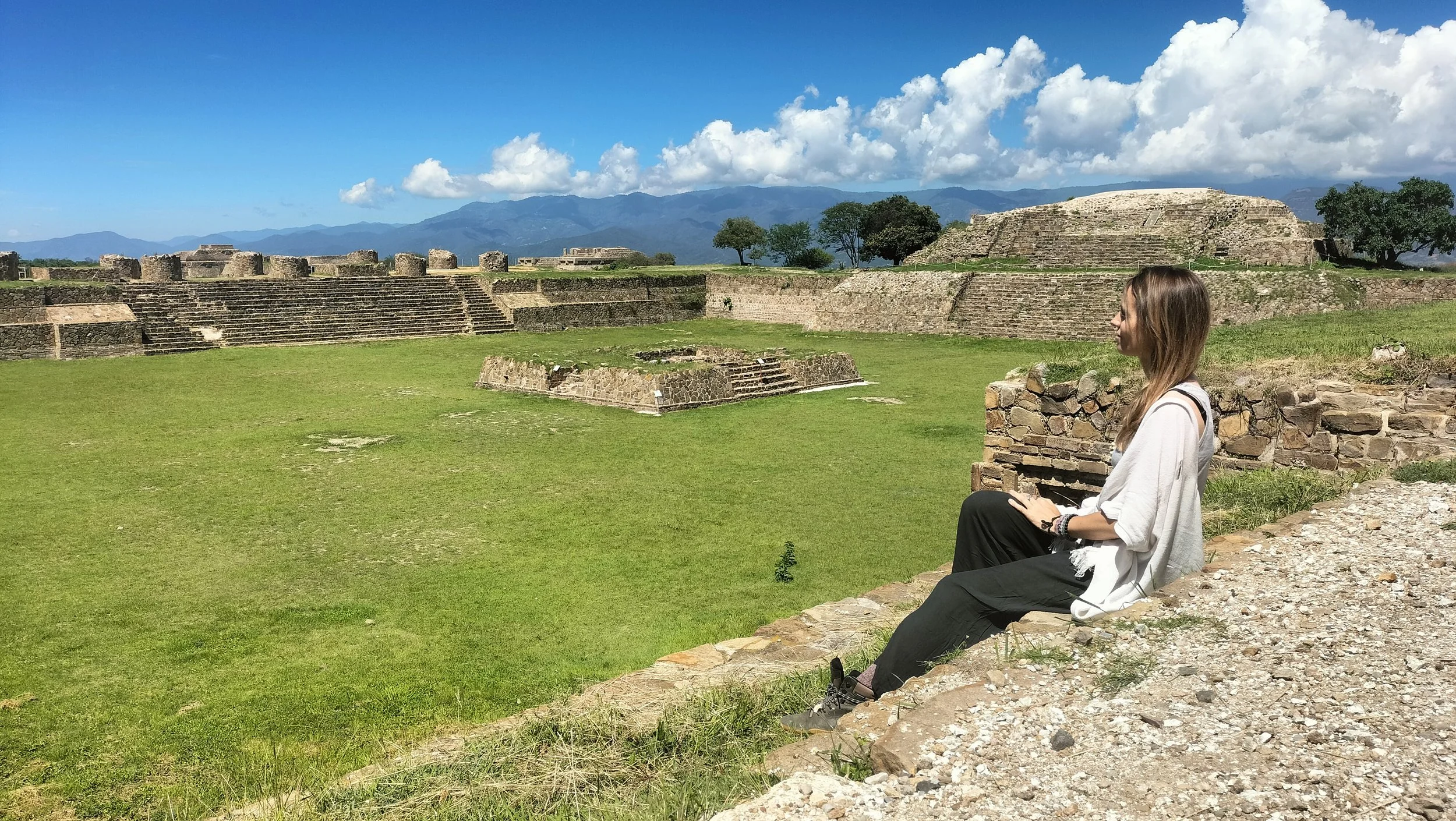
Known as "Sacred Mountain of Life" in Zapotec, this site sits just outside of Oaxaca City and is the cosmic capital of the Zapotec — the "People of the Clouds" (Binnizá). Where Mitla dealt with the underworld, Monte Albán was the celestial engine: the place where the Zapotec state negotiated with the sky, the rain, and the ancestors. It’s an important site with lots of deep esoteric aspects but for me, I didn’t feel like much needed to happen there so I just enjoyed walking around mostly.
San Cristóbal de las Casas
I was relieved to be back on the road and go somewhere quieter. It was a rocky nightbus but it got me to Chiapas, to the pretty town of San Cristóbal de las Casas where I had a nice hotel room and something to eat besides tortillas. It’s the living heart of Maya shamanism: away from prying tourists like me, in the mountains, they’re still secretly practicing this stuff. I felt my own energies activate more as I got to this region. Somewhere in here still lives a Maya and my body was responding.
San Juan Chamula
I visited the church in San Juan Chamula. The floor is carpeted in pine needles, the air is thick with copal incense, and Coca-Cola is used in the ritual — burped to expel negative energy. I was bursting with curiosity and questions, but it would take a lot longer to gain trust and entry to the mysteries here than I had time for. I relaxed and basked in the mystery and gratitude that not all of it was completely lost.
Solstice
The other thing that apparently was meant to happen was that I was randomly invited to a Maya shamanic ritual on the morning of the summer solstice which was a real surprise and blessing. I’ll leave it at that.
Palenque
The route got really intense heading out of the city and through the forests to the sacred site of Palenque. Where Teotihuacan made the sun and Cholula channeled the Feathered Serpent, Palenque enacted the cycle itself: descent into the underworld, death, and resurrection as a celestial being.
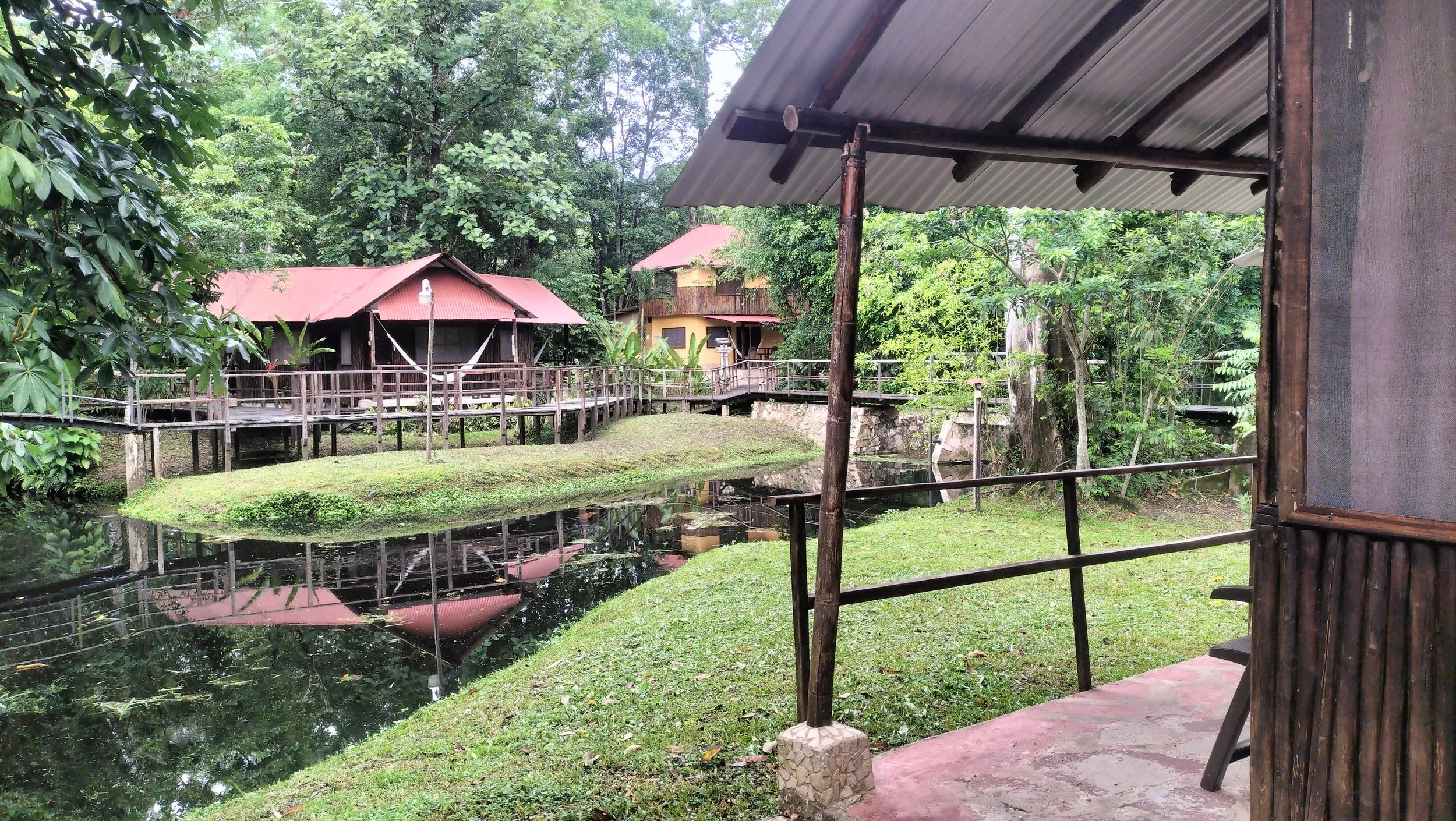
I stayed in a hut in the jungle surrounded by howler monkeys groaning which gave the whole trip a very sci-fi kind of feel. This was definitely one of the more relevant places for my energy work. I got there and was flooded with memories of being a priest and performing rituals at the site. I felt like some of that was being reactivated within me. A part of the site was closed off as a tree had fallen over one of the temples and something beckoned me to jump the barrier and investigate. The land registered my presence and I clumsily asked permission to be in the space. Not granted. I was meant to see only how the tree had fallen to allow space for the spiritual energies to recover without the presence of tourists messing things up. I dipped into my bag to offer a little tobacco when someone came up behind me.
It was a local guy in his early 20s, claiming he was a guard but didn’t look like one. I looked super guilty. He asked if I was smoking and I said ‘no I’m leaving an offering. The tobacco is sacred’. He got it. ‘Look,’ he said. ‘I’ll show you the forest’. He was someone who still practiced Maya spirituality, and we wandered through the forest over vast areas of the ruins that had not yet been excavated. He revealed some of the deeper secrets there and gave me an energetic initiation that involved connecting my energy body in various ways with different stars and planets. Then we were done.
Calakmul
Next. The site of Calakmul (ancient Maya: Ox Te' Tuun, "Place of Three Stones") lies deep in the jungle of Campeche, ~35 km from the Guatemalan border, and is the throne of the Snake Kingdom — the single most powerful expression of the Feathered Serpent thread in the Maya lowlands. Where Palenque enacted death and rebirth in intimate stone, Calakmul was the serpent itself: a city built to be a living embodiment of the Kaanul dynasty, where the snake was not a symbol but a political and cosmic identity.
I stayed in a homestay cabin near Escarcega and tried to figure out how to do the trip within my budget. The answer was: wing and hitchhike, basically. Getting as far as the entrance on the main road was easy. But it was still a 2 hour drive from there deep into the jungle and it was low season and there was no one there. I sat around in the blazing heat of the Mexican summer sun and contemplated my options. Then, a young couple from Mexico City pulled up and told me to hop in. Problem solved.
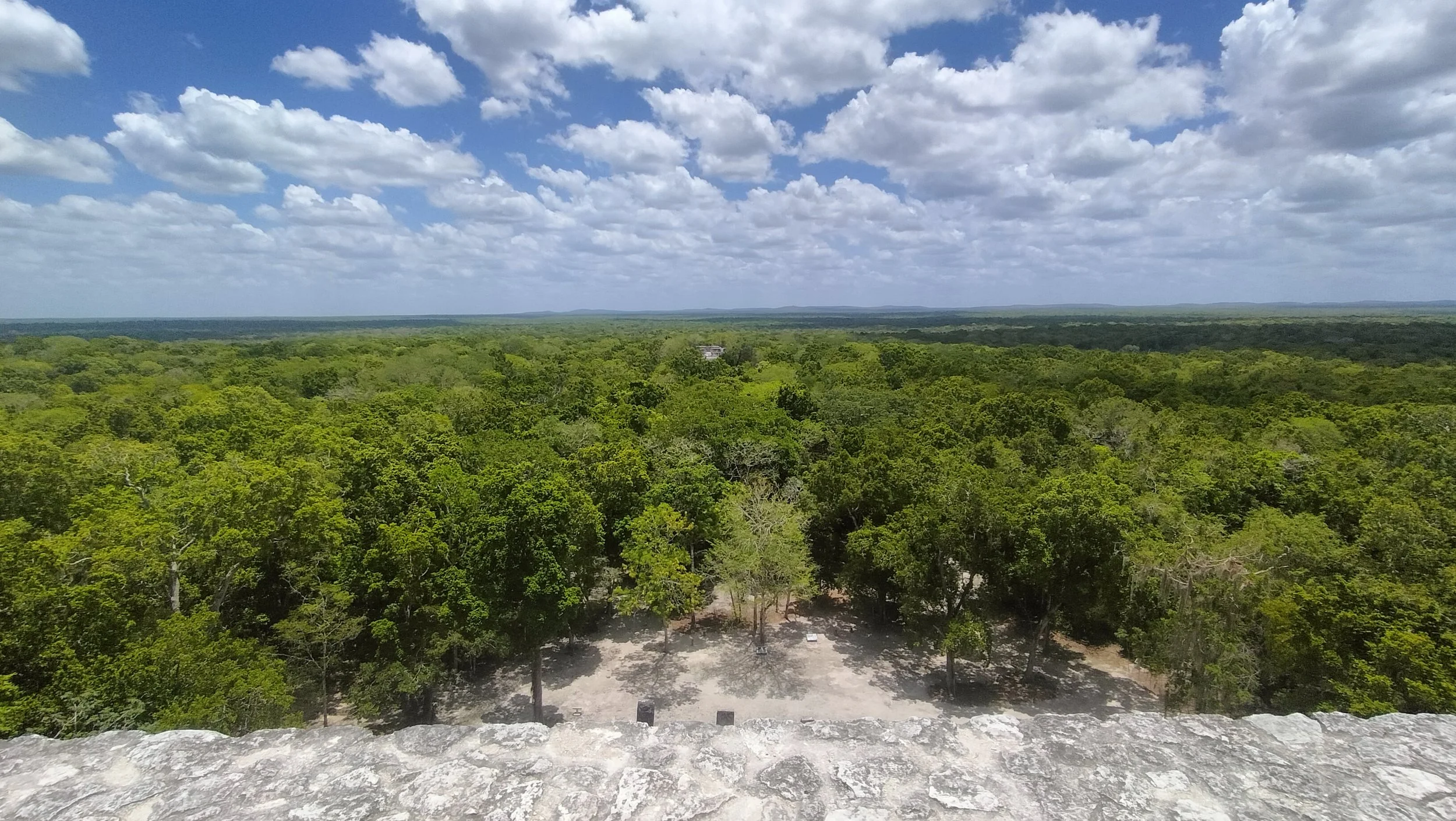
The site is massive and recently excavated. The Great Pyramid (Structure II) is the cosmic center of Calakmul. It is identified with Witz — the mythical sacred mountain of creation, the first land to emerge from the primordial sea. The Maya read the plaza as the Primordial Sea and the great platforms as the Mountains of Creation rising from it. Structure II is not a tomb or a temple; it is the mountain itself, rebuilt and overbuilt by successive kings across a millennium. At its base, three massive monolithic altars represent the Three Hearth Stones — the sacred fire of creation. In Maya cosmology, the hearth is the point where the gods made the world. The association with Orion (the "three stars" of Orion's Belt) makes the altar a terrestrial anchor for a stellar event: the birth of the cosmos, replayed in stone at the center of the city.
I am most certainly not an expert in Maya history so I'll encourage you to research it more in your own time but for me, what I got from it was the theme of Pilgrimage. Researchers have determined that Calakmul was a pilgrimage site during AD 1000–1500 — after the Classic collapse and the abandonment of the city proper. The offerings found inside buildings indicate that post-Classic Maya communities continued to travel to Calakmul for ritual purposes even after the city was no longer inhabited. It chimed with my own struggles to get there and back (which was harder), and it felt like the site honours you in some way if you make the effort.
Bacalar
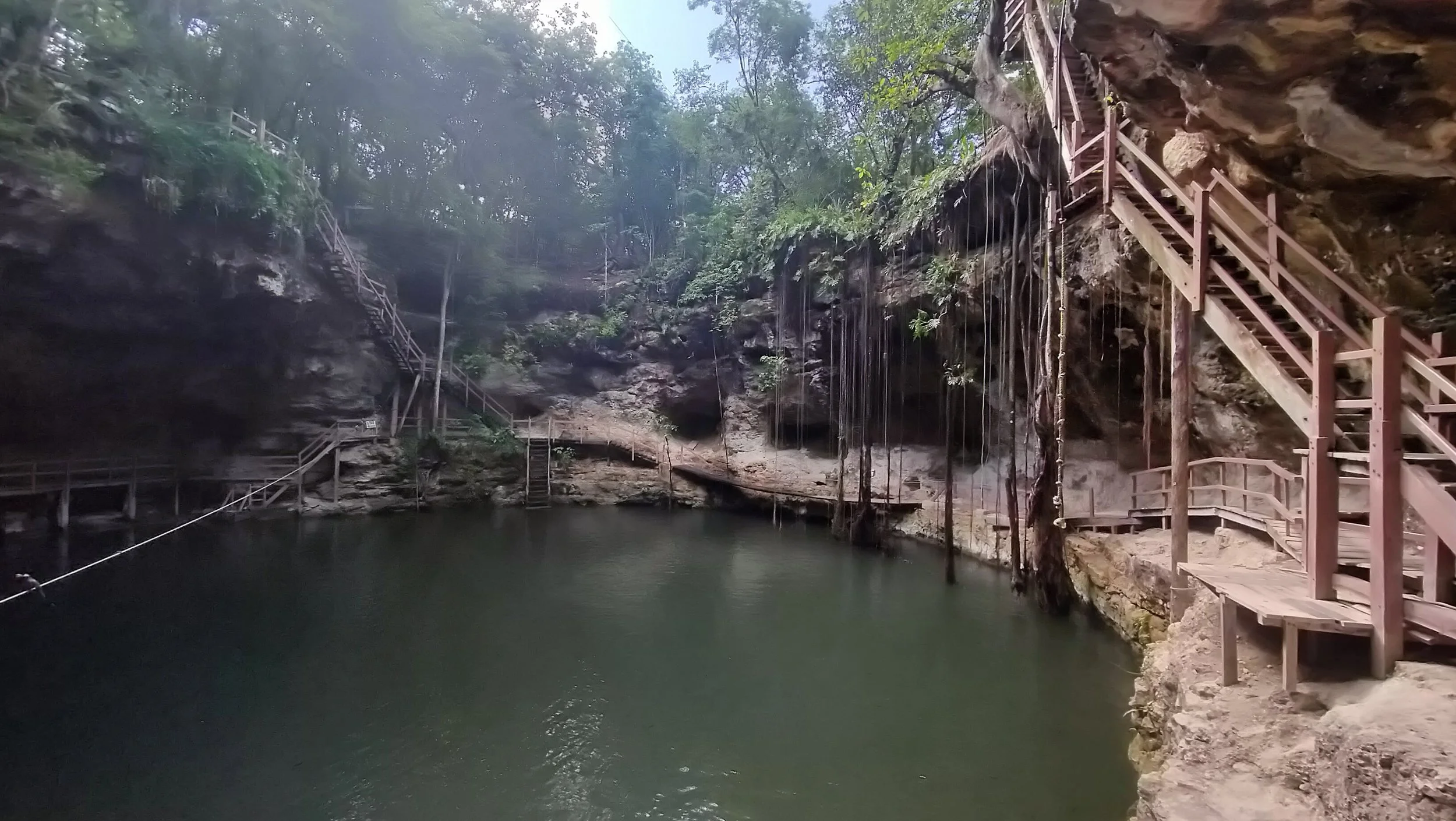
After all that, I was looking forward to arriving into the tourist town and sacred site of Bacalar. I took a TrenMaya, and pulled up late at night in town. A friend of mine had spoken really highly of the place and I had about 5 days to relax there. But the next day, I wasn’t really into it. Touristy. Not my vibe. There are some lovely spots don’t get me wrong – the lagoon, the cenotes – but anyway, check out someone else’s blog on that if you’re interested in the town.
Ichkabal
Nearby, the City of Snakes is a major Maya site and has been identified by researchers as the possible origin point of the Kaanu'l (Serpent) dynasty — the same dynasty that ruled Calakmul. If Ichkabal is the birthplace of the Serpent dynasty, then Bacalar is not merely a destination on the Feathered Serpent thread — it is the source. Interesting that the serpent did not begin at Calakmul; it hatched here, in the water.
Tulum
Visited the site but not many downloads. It’s more of a portal to the water realms and didn’t feel too relevant for me. Also it smells of rotten seaweed this time of year. Tulum’s a major tourist site and I’m not going to give it any more words than it needs.
Chichén Itzá
The renowned site of Chichén Itzá near Valladolid is the cosmic engine of the northern Maya world — the point where the Feathered Serpent thread, the underworld, and the astronomical calendar are fused into a single, functioning machine. Where Calakmul was the serpent as state and Palenque was death and rebirth in intimate stone, Chichén Itzá is the serpent as calendar, as portal, and as city: a place where cosmology is not encoded in a single monument but in the entire urban grid. This was another one I felt was strongly beckoning me. I felt almost nervous to go. This was a place of a lot of karmic lessons for my soul.
Fortunately no string of problems like at Teotihuacan. It went pretty smoothly. I meditated with the cenote and felt the aliveness of this portal even still. Then I walked on instinct past the pyramids and stalls selling skulls to the Castillo observatory. I sat, tuned in, and saw the Maya calendar open up around me like a multidimensional Swiss watch of cogs and spirals, still alive as a mode of space-time. With reverence, I attuned to this.
On my way out, I prayed and atoned for things I did in that life that I’m not proud of and felt like I’d probably done enough, at least for now.
Coba
An important site which I skipped because I got so annoyed with the officials trying to skim cash off the tourists. It was more expensive than any of the sites and it crossed a boundary for me. They didn’t take kindly to my accusations of corruption so I took my cue to leave and swam in the cenote instead. It was lovely.
Uxmal
I headed to Merida, another city I did not get on with, and somehow navigated by bus and whatever I could find to another remote site called Uxmal. Time was getting tight but it felt really important that I go, and I was glad I did. Uxmal is the feminine pole of the northern Maya world — the complement to Chichén Itzá's geometric, priestly, masculine precision. Where Chichén Itzá is the cosmic clock, Uxmal is the cosmic womb: a city where the architecture is not a machine for measuring time but a living body — rounded, breathing, and tuned to Venus, the moon, and the rain.
It was the Pyramid of the Magician that had called me. It has a reputation for having an ancient mystery school and links with shamanic initiation. When it’s your time, it brings you there.
And then time was up. Time to head to Ireland.
