
Van tales 5: Scotland Initiates
I pulled up to the suburban driveway of my parents’ house in my huge, graffitti-splattered van, choking up the quiet cul-de-sac with my exhaust fumes in the process. My dad came out to make sure I didn’t crash into anything and pretended not to be embarrassed. I ate a bowl of my mum’s minestrone soup and settled into the guest room which I’d basically claimed as my own, dumping a whole bunch of accumulated personal objects onto the clean, empty shelves.
It was nice to be home but I wasn’t going to hang around here long; I had a long trip to take. I had been inspired by the pentagram vision I’d had in Wales and the geomanancer David Fulong’s work which also speaks of the major Scottish sacred sites forming a geometric pentagram pattern across the landscape based on anceint ratios. The two together fit too neatly to pass up. The points of the pattern are: The Ring of Brodgar (Orkney), Callanish Stones (Isle of Lewis), Iona (Inner Hebrides), Skellmiur Hill, Mavishall, Loch Moy, Cape Wrath and Loch Lomond.
My route wasn’t going to be a clean trace of this though, I was also following the Belinus Line, a key ley line from North to South of the UK as written about in the Spine of Albion. I had been tracking this on my way North already. I also had my own mystical and personally relevant points planned and that the trip would guide me to. I could sense a lot of it had to do with star beings and there was also something about this trip that was meant to be deeply healing for my family and ancestry. So I stocked up my van, and with both excitement and a pang of feeling like a little kid having to go on their first school trip. I waved good bye to my parents and set off on my big adventure.
Rosslyn Chapel
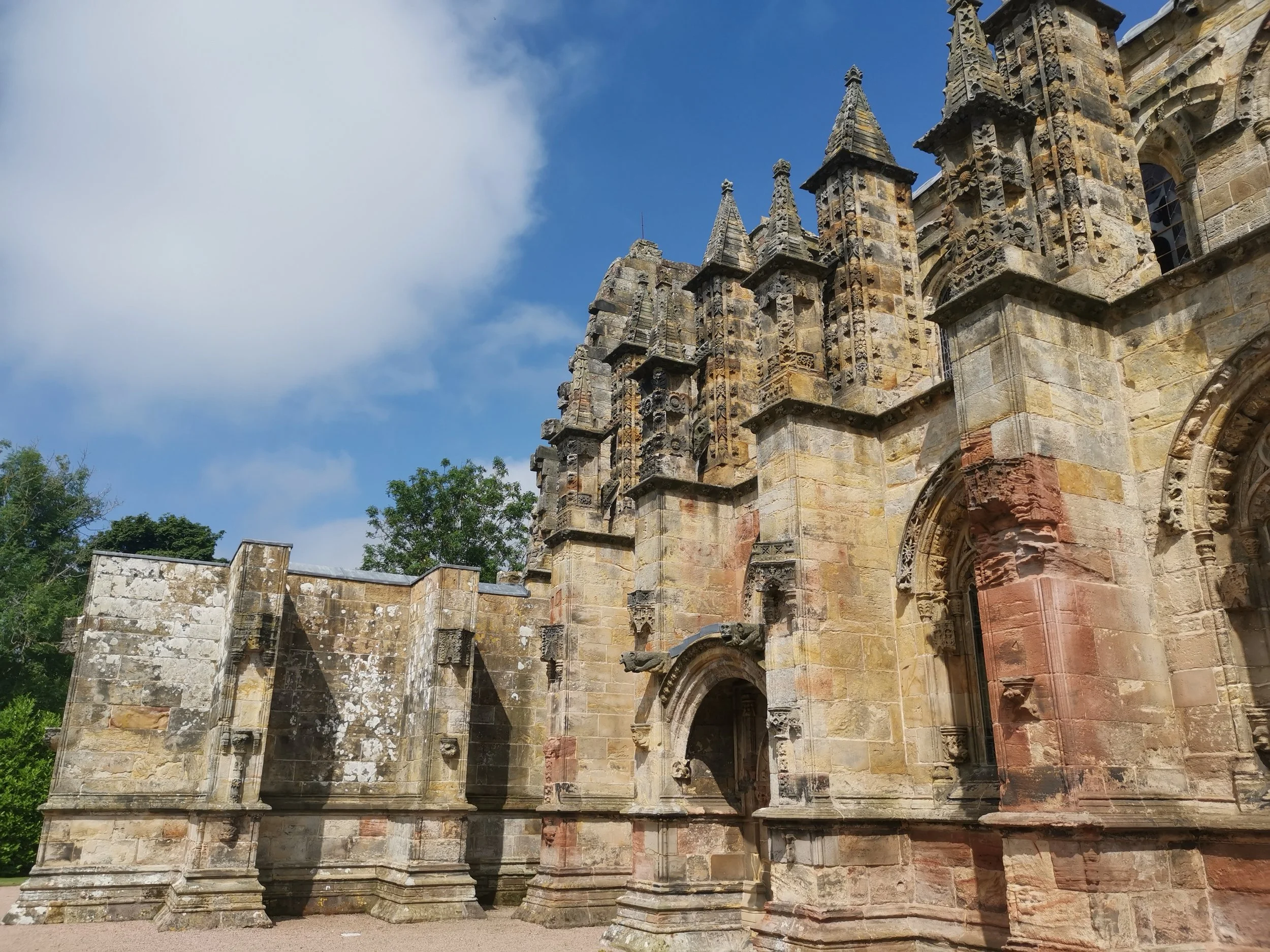
I started at the famous Rosslyn Chapel, home of the occult, and climbed my way down into the crypt. Etched on the walls are medieval masonic carvings and symbolic geometry, including pentagrams. The Chapel was built by the Sinclairs and is packed with magical codes. It's a cube you can walk through, with 215 carved cubes in the arches, each one a different pattern. Thirteen angels playing instruments at the top, eight dragons at the base, and the whole place oriented so you walk through the year as you walk through the building. The patterns have been played back on medieval instruments and the stone resonated. The code is acoustic; you don't read it, you hear it.
Then, incongruously, you have the Green Men. A hundred of them, their faces with leaves growing out of their mouths. Pagan of course. From before the code was written. The code is on the walls, but the Green Men are in the cracks. I didn't really know what it all meant, but my feeling both at the Chapel and in the surrounding park was that there were many beings there — nature spirits, masters and magicians, — who still reside on the astral plane. I could sense a campus — structured, institutional, ongoing — and how beyond the earthly realm, the ancient pagan powers and the energies of the Western Magickal and Masonic Orders are still very much alive.
I paid my respects and felt like I’d been granted their blessing and support for the trip.
The Fortingall Yew
If you read my article on One Yew Wood, you’ll already know I have a thing for Yew trees. Well, this particular tree had been calling me for months already. Aged anywhere between two and five thousand years old it’s widely considered the oldest living tree in the UK and Europe. Given the link with Yews and the cycles of death and rebirth, this tree’s structure is the perfect example of that, looking actually like several trees but all connected as one being. What I had felt from it was that it was the pituitary gland of the UK. It’s location in a parish in Perthshire mirrors that location if the UK were mapped to the human body. And its wisdom is coordinating a lot of the ‘aging’ or development process of the land itself. Connecting with this staggering being felt like having the Grandfather of the land send me off with a list of useful advice. Whereas Rosslyn gave me the magicians’ blessing, the Fortingall Yew gave me the blessing of the land itself.
As I crossed the Cairngorms towards Aberdeenshire at some point the reality of my life started to hit me. It had been about eight months since I’d left my life in London behind, but this was the first time I was beginning to really feel the freedom I’d bought myself. It was a glorious summer, I had everything I needed in my van, and the days of being crammed on a platform in the London Underground or staring at my screen at Microsoft felt like some surreal old dream. I parked up, washed myself in the glistening river, and had a picnic.
Skellmuir Hill and Deer Abbey
I headed north east to Skellmiur Hill, one of the points of David Furlong’s map. Um, well, it kind of flopped. If you follow the coordinates it takes you a farmer’s field. And indeed, he jumped out of his combine harvester very confused about why I was roaming around in his field. Couldn’t find the stones. Gave up and left. No sacred energies. Nada.
I stopped by in the village where my grandparents had lived, then headed to the neighbouring village of Old Deer, whose spiritual significance spans centuries. This place serves as the bridge between ancient Celtic mythology, early Christian monasticism, and modern mysticism. Though the modern village is quiet, it sits on land that has been considered a sacred gateway for thousands of years. I went to Deer Abbey, the old monastery, and felt the tranquility of the monks as well as something much bigger. Here lives a great Deer Spirit, wishing to have its presence remembered. I was shown how it used to hold a very important governance role for the land, providing oversight and leadership over the territory.
The famous Book of Deer, Scotland’s most sacred text, was named for this site. It’s less a gospel than a title deed. The monks used to write what they actually cared about in the margins: land grants, property rights, the founding legend of the monastery land grants, in Gaelic, and this holds all the insight. I sensed how the book itself was somehow linked to the power of the Deer. The book left Scotland in the 13th or 14th century and has been in Cambridge since. The deer is still here but the deed isn't.
Onwards…
Want more like this in your inbox? Follow me on Substack or subscribe below.
