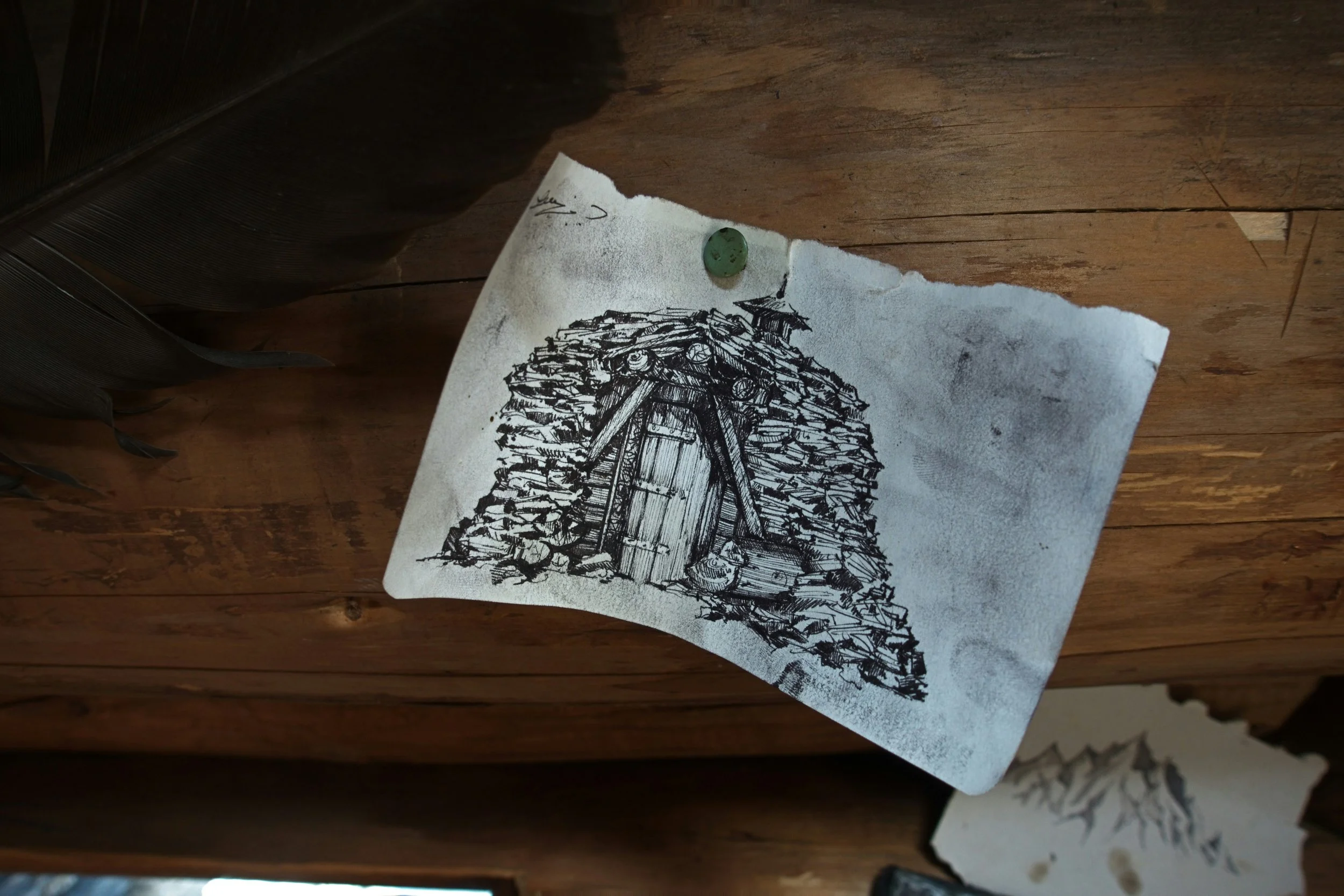
When you wake up and the dream has already done its work, the question isn't 'what does this mean?' It's 'how do I feel different?'
Like many people, I’ve always had a strong connection to my dreams. I remember as a teenager eagerly recounting what felt like full feature-length movies each morning enthusiastically to anyone who would listen. I’ve kept a dream journal for years and cherish savouring the moments of a dream, lingering in the atmosphere of what it was bringing up for me – sometimes in bliss, peace and comfort, sometimes in great discomfort – but always in awe at the intelligence and mystery of the dreaming function.
Later, I got into dream interpretation. Not just looking up what ‘teeth falling out’ means in a dictionary, but exploring dreamwork from a Jungian and shamanic perspective, and as proposed by Bill Plotkin and other depth psychologists. Not just ‘this means that’, but more of an immersive approach to dreamwork. I had a couple of years working with a Jungian therapist who taught me to look at my daily life – that a specific colour in a dream might remind me of the colour of the curtains I was looking when my ex told me he was having an affair. A dream dictionary can’t give you that.
And as I started working shamanically with tobacco on plant medicine ‘dietas’, I opened to the possibility of plants taking the driver’s seat of the dream machine, and how that lends a whole new perspective on the function of dreaming as a whole.
I’ve experienced different approaches to dreamwork on dieta. Some Western facilitators take a very proactive approach to dream analysis, making it the central focus of the dieta itself, and dedicating considerable time each day to helping work through the symbolism and unearth psychological insights. Many students value this approach and get a lot from that work. It’s also an accessible entry point for a lot of people and a meaningful value add. It feels like a valuable phase, but I’m not sure whether it’s necessarily the destination. I’m still holding that question.
Others will let the dreams be there, but place little conscious emphasis on doing anything ‘with’ them. I’ve been exploring what works for me, and I’ve found, for the most part, I prefer the second approach. On dieta, your consciousness naturally shifts out of the logical monkey mind state we typically operate in, and moves towards something more quiet and spacious. The analysis, I’ve found to be jarring. And even subsequently out of dieta, I’ve been feeling a similar way. I’ve been looking to my dreams in the morning to ‘decode’, and the answer I get is ‘the work was done. No need to meddle.’ It sparked my curiosity about traditional approaches to dreams. Here’s what I found.
Tobacco shamanism
Aside from the Mamancunawa lineage I work in, other documented shamanic tobacco traditions treat the dream as a reality, not a text to be decoded. The Wauja shamans don't interpret their tobacco visions; they draw them, because the point is to render the spirit's form, not to decode its meaning. The Yaminawa use tobacco specifically as the dreaming vehicle — "ayahuasca makes you see, tobacco makes you dream" — and the dream is the spirit's own mode of address, not a puzzle. The Runa of the Upper Amazon don't interpret dreams so much as consult them, and when they fail to read a sleeping dog's dream, the question that arises isn't "what does it mean?" but "can we even access the intentions of other selves?" — which is an entirely different epistemological register than "what does the symbol represent?"
For me, I’ve learned that the smoke in my dieta isn't a symbol for the tobacco spirit. It is the tobacco spirit, teaching. The dream isn't a message about something else. It's the plant's method of instruction, and I'm in the classroom. And what actually lands — the few key insights, the lingering feelings that outlast the image — arrives in a form that isn't propositional. It's not a statement I can write down and bring to the next session for amplification. It's often simply a residue. A warmth. A shift in how something is held in the body. And a knowing that something, somewhere, has healed.
Western psychology
Jung
We’re all familiar with the standard frame for dream interpretation — the one that runs from Freud through the institutional Jungian tradition into the pop-psychology bestseller — treats the dream image as a representation. It stands in for something else. The snake represents the shadow. The water represents emotion. The figure represents an aspect of the self. The dream is a text with a meaning behind it, and the interpreter's job is to extract that meaning. I get that there’s some value in that and do think the cosmos speaks in symbols that are commonly recognisable. Magick is built on a system of correspondences.
But Jung made a distinction that matters here, even if the tradition he founded has mostly forgotten it, or chosen to overlook it perhaps. Whereas a sign has a fixed, one-to-one meaning – a stop sign means stop – symbol is alive, multivalent, irreducible to a single translation. In Man and His Symbols, Jung wrote that no dream symbol can be separated from the individual who dreams it, and went as far as to call the fixed-meaning approach "plain foolishness." Modern Jungian analysts have kept the vocabulary — archetypes, amplification, the collective unconscious — but their practice operates closer to the sign than the symbol.
Jung’s own view changed over the course of his life. The psychoanalysts of the institutional Jungian tradition today mostly practice the middle Jung period that produced the compensatory theory, the four levels of interpretation, the amplification method. It's codifiable. It can be taught in a training program, assessed, and easily replicated. While I’m sure most analysts aren’t working that simplistically, they’re nonetheless building their offering on the work-in-progress hypothesis, not the finished perspective. This is also the version of the work we most readily see in derivates in New Age ‘wellness culture’ and the like.
Jung’s later work crystallized in the 1961 essay "Symbols and the Interpretation of Dreams". This dismantles the very law the middle period established, and instead proposes that there is "no rule, let alone a law, of dream interpretation." Each dream must be approached as a new, unrepeatable experience. He doesn't give you a practice. He gives you a warning against the practice.
Hillman
But the deeper problem isn't fixed meanings. They’re there to some extent, and to some extent not. It's the hermeneutic frame itself: the assumption that the dream is a text, that there is a meaning behind the image waiting to be extracted, that the dreamer's job is to decode. When the dream is a process — the psyche doing its own work, the bardo unfolding, the healing happening in the dream itself — you're trying to narrate a process, not decode a message. The tool is for a different job. Using it anyway is meddling.
Hillman puts the meddling in a single sentence:
"Interpretation arises when we have lost touch with the images, when their reality is derivative, so that this reality must be recovered through conceptual translation. Then we try to replace its intelligence with ours instead of speaking to its intelligence with ours."
The key word is replace. The dream's own way of knowing gets swapped out for the dreamer's, and the dream is left as a husk — a set of images that have been drained of their intelligence and repackaged as a lesson for the waking ego. Hillman's metaphor for this is ugly in a way that touches the intrusiveness of the approach very viscerally:
"To interpret the dream is to exploit it, as a capitalist exploits a vein of coal, transforming those fossilized remains into a commodity, something that can be measured, evaluated, bought and sold."
The dream is the vein. The interpretation is the commodity. And the dream, once mined, is done. It's been extracted, and what's left is a residue that the dreamer can carry around in a journal, but it's not the teaching. It's the coal dust.
What Hillman is asking for instead is closer to the shamanic approach.
"For a dream image to work in life it must, like a mystery, be experienced as fully real."
The image is a mystery, not a puzzle, and those require different responses. A puzzle has a solution. A mystery has a presence. You don't solve a presence. You sit with it. You let it do its work at its own pace. "Each dream has its own fulcrum and balance, compensates itself, is complete as it is." That last clause is the one that undoes the whole clinical frame. The dream is complete as it is. It doesn't need you to finish it. It doesn't need a meaning. It doesn't need to be useful. It's already done. Your job is to notice that it's done, and to let the feeling land.
Different dreams, different functions
I think the meddling isn't in interpretation per se. It's in applying interpretation to the wrong kind of dream.
Ordinary dreams. Residue. The brain filing its day. The day's sensory input recombined into noise. Not significant. Interpreting these is noise-making. The Buddhist position on this is blunt: most dreams "have no importance and need no interpretation." They arise and pass.
Symbolic / archetypal dreams. The Jungian territory. The psyche speaking in metaphor to itself. The dream is a representation here — it's the unconscious using image to communicate with the conscious mind. This is where amplification and personal association have legitimate work to do. The institutional method is most defensible in this category. But even here, the late Jung's caveat applies: the interpretation is provisional, corrigible, never final. It's a hypothesis, not a verdict.
Educational / instructional dreams. Here, the dream is a lesson being delivered, not a puzzle to be solved. The smoke as the tobacco spirit. The wise old man as your Higher Self. The instruction arrives as understanding — a flash, a shift, a knowing that isn't propositional — not as a statement to be decoded. The teaching is happening in the dream, not for the dreamer's waking comprehension.
Journey dreams. Going off somewhere. The dreamer doing its own work. You're not the protagonist — you're a witness, or a participant in a process that doesn't require your conscious narration. The healing is happening in the dream, not for the dreamer's waking understanding. The work is done by the time you wake up. The dreamer — that aspect of yourself that is doing the work, that you aren't yet ready to meet or be — is proceeding at its own pace. Your job is to let it.
The not-yet-ready dreams. Aspects of yourself that the psyche is not yet prepared to bring into waking consciousness. The dream is doing the work of preparing you to meet them, not delivering them to you. Premature interpretation is premature integration. You're pulling the thread before the knot is ready to come undone. This is where the meddling is most literal: you're interfering with a process that is proceeding in its own time, in its own way, and your conscious mind is not the right agent for it.
The right response to each kind of dream is different. The hermeneutic frame is one tool, appropriate for one or two of these categories. Applying it to all of them is the meddling. The question isn't "what does this dream mean?" It's "what kind of dream is this, and what does it need from me?" The answer can be: nothing. Just witness. Just let it be. Just let the feeling land.
The Tibetan Buddhist frame
The Tibetan Buddhist system gives the "not interpreting" position a full, worked-out architecture behind it. It's not anti-intellectualism. It's a method — a different method, with its own logic.
The dream as bardo. In the Bardo Thödol framework, the dream is one of the transitional states — structurally parallel to the bardo of dying. It's not a representation of something. It's a state of consciousness with its own reality, its own dynamics, its own logic. You don't interpret a bardo. You navigate it. The dream is a place, not a text.
Blessing dreams as illusory. This is the key practice, and it's the exact opposite of interpretation. You don't extract meaning from the dream. You release your attachment to it. You let it be what it is — vivid, functional, real-as-experience — without freezing it into a fixed meaning. The attachment to "what it means" is what causes suffering, not the dream itself. The practice is to recognize the dream's vividness, recognize its unreality, and hold both simultaneously. Not "this means X." "This is happening, and it is not solid, and I don't need to make it solid by naming it."
The illusory body. The broader insight: the dream isn't just a dream. Waking life is the same. The dream is where this is most accessible, because the unreality of appearances is most visible in sleep. The practice is to carry that recognition out of the dream, not to mine the dream for content to bring back. What would you think if someone were to wake up tomorrow morning having dreamt your life and tried to pick apart what you going to the supermarket means?
Clear light. What the dream dissolves into. The ground beneath the image. The "lingering feelings" that outlast the dream's narrative are probably this — the residue of the encounter once the image has done its work and dissolved. The teaching arrives in the clear light, not in the narrative. You don't need to write down what the dream "meant." The feeling is the teaching. It's already done its work.
So, the goal is to move beyond meaning or interpretation altogether. It’s about the practice, not the appearances. Just like meditation. You don't sit down and ask "what does this thought mean?" You let it arise and pass. The dream is the same. The dream is a thought that lasts eight hours.
What's left
All I can say is what I’ve noticed in how my own dream practice has shifted. And I’ll say it’s less formal than it was. I’ll ‘touch in’ with the dream when I wake up, and feel whether it wants me to engage. I distinguish between that and resistance, which often may try to get me to dismiss the dream. That’s different, and signals there’s a reason to lean in more, rather than less.
For this, neo-shamanic style practices such as drawing my dreams, movement, singing, sitting with the somatic sensation of the dream, and reflecting on key symbols, parts analysis and so on, give me what I need. I’m grateful I’ve learned these techniques from all kinds of sources – from Internal Family Systems, to Robert A. Johnson’s book on Active Imagination, to Animas Valley’s dream programs, and other depth-psychology influenced modalities. There’s a lot out there.
I’ll often still record a dream on my dictaphone in the morning, and write it in my diary, sitting with it for a while. Seeing if there’s anything that’s calling for my attention. A pull. A whisper. Subtle or loud. But also, often I won’t. I get on with my day. I trust my dreamer’s got my back. And with that, I actually feel like we’re closer teammates collaborating on ‘project Nat’, rather than feeling more disconnected. I don’t know if that’s it now or if it might change how I approach dreaming again. I think our relationship with our dreams can evolve. But I’ve come to understand that my Shaman’s restraint during dieta isn't a lack of interest or understanding. It's a deceptively skillful way of holding space for dreams in general.
Dreams sell. There is a thirst for connection with our dream worlds, and the line between healing and extraction is easily crossed. The hardest part for us Westerners is to not interfere. To not need them to have a meaning. To make them useful. The dream that is only a dream — that teaches nothing, means nothing, just is — is the one that's hardest to sit with, because it refuses to be a resource. And that refusal is the point.
When you wake up and the dream has already done its work, the question isn't always "what does this mean?". It's "how do I feel different?"