The mother who stopped the sun. The magician who traded a serpent for a secret name. What Isis actually does in a healing ceremony.
Isis, or Aset as she was originally known, is a Goddess we've all at least heard of, and she's easily relatable.
Meaning "the throne," her name is the hieroglyph for the throne — the seat of power — and she wears it on her head. The Greeks heard it and made it "Isis." Generally known as the "Goddess of 10,000 Names," the titles reflect themes of magic and power (Great Lady of Magic/Spells), cosmic protector (Lady of Heaven), and maternal themes (Mother of the Gods). As Healer of Broken Dreams, the Sorceress Who Heals, she carries her medical and restorative powers.
Isis is indeed a magician and a healer. She has a light and a dark side. She's gentle and nurturing. And she's fierce when needed. In the Egyptian healing texts, her magic is restorative: her spoken words avert venom and fever while her wings shield and her milk nourishes. She doesn't send the problem away. She goes in and rebuilds.
The story that does the orienting: the infant Horus, stung by a scorpion in the delta marshes. Isis cries out across the heavens. Ra's barque stops. Thoth descends and teaches her the spell. She speaks it. The child lives. Every healing spell in the Egyptian corpus is built on that moment — the mother who will stop the sun rather than lose her child, and the words that fix what's broken. She's the template. Every patient is Horus. Every healer is her. That's why I use her spell in my ceremonies.
She also healed Ra. Which is the one that gets retold, because it's the one where she's not the mother, she's the magician. She made a serpent from his own spittle, set it to bite him, and when no god could cure the venom, she offered to — for his secret name. His true name. The one that held his power. He gave it to her. She became Weret-Hekau. Great of Magic. The one whose heka transcends the rest.
That's the distinction that matters for the work: she's not a comfort goddess. She's not the one who holds your hand and says "it'll be alright." She's the one who goes in, finds the thing that's wrong, names it, and rebuilds it. The comfort is a byproduct. The work is the point. In practice, she's always come through keen to work and support in the ceremonies.
Working with Isis for healing is always an eye opener. I learn so much from watching how she works with energy. I create the container for the work, and then invoke her as part of the ceremony. When she comes in, it's often not just about you being passive. It's relaxed, but we're all working together. She'll show me step by step what she's doing, I typically narrate that, and the client follows along with their mind — lying back and visualising what she suggests, or simply listening. There's no expectation to perform or to try too hard. The idea is that we're all on the same page, working on the same thing. It's not always that way, but that's typically how she likes to work.
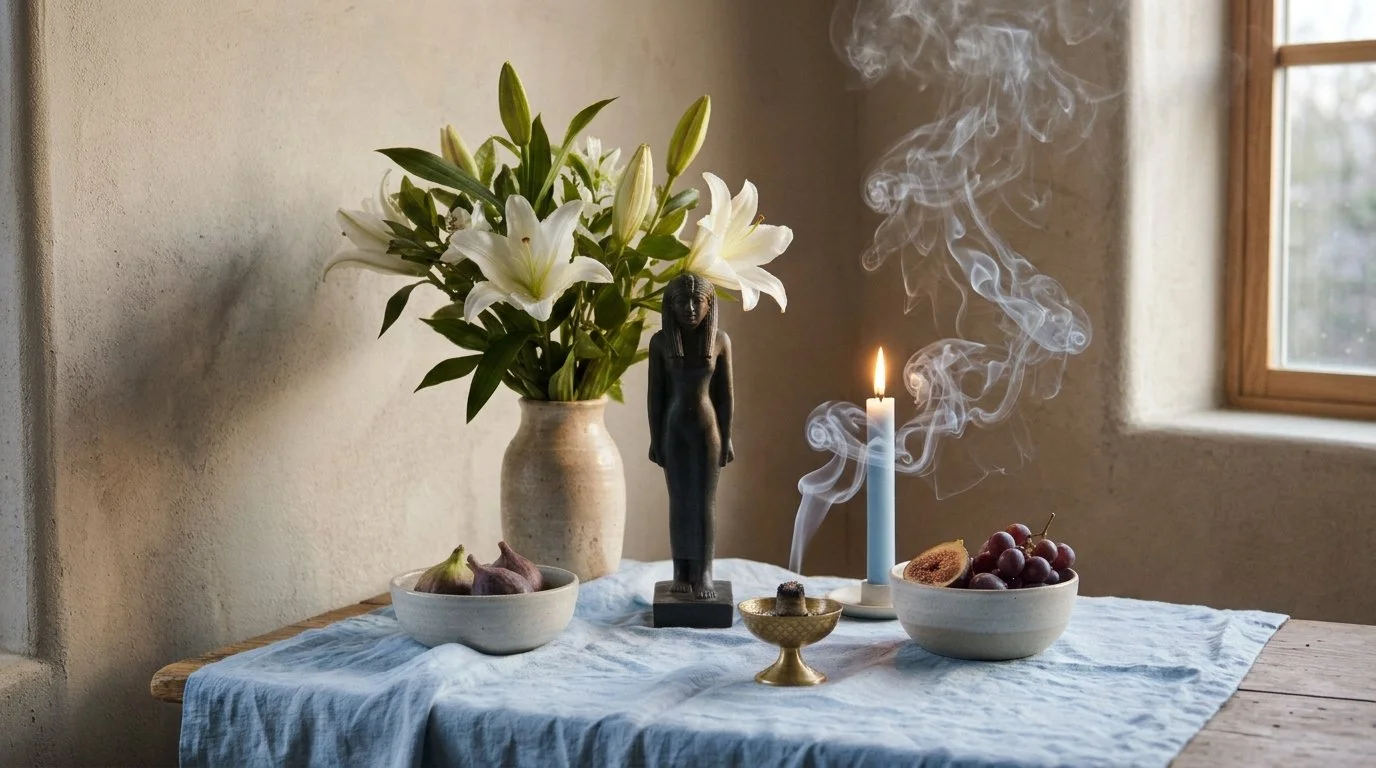
The format lasts an hour, and if you'd like to make your own offerings as part of the ceremony I give you guidance on how you can prepare for that in advance. But it's optional. I've got it covered.
If you'd like to read about how my connection with Isis began and how the initiation happened, I've written about that here.