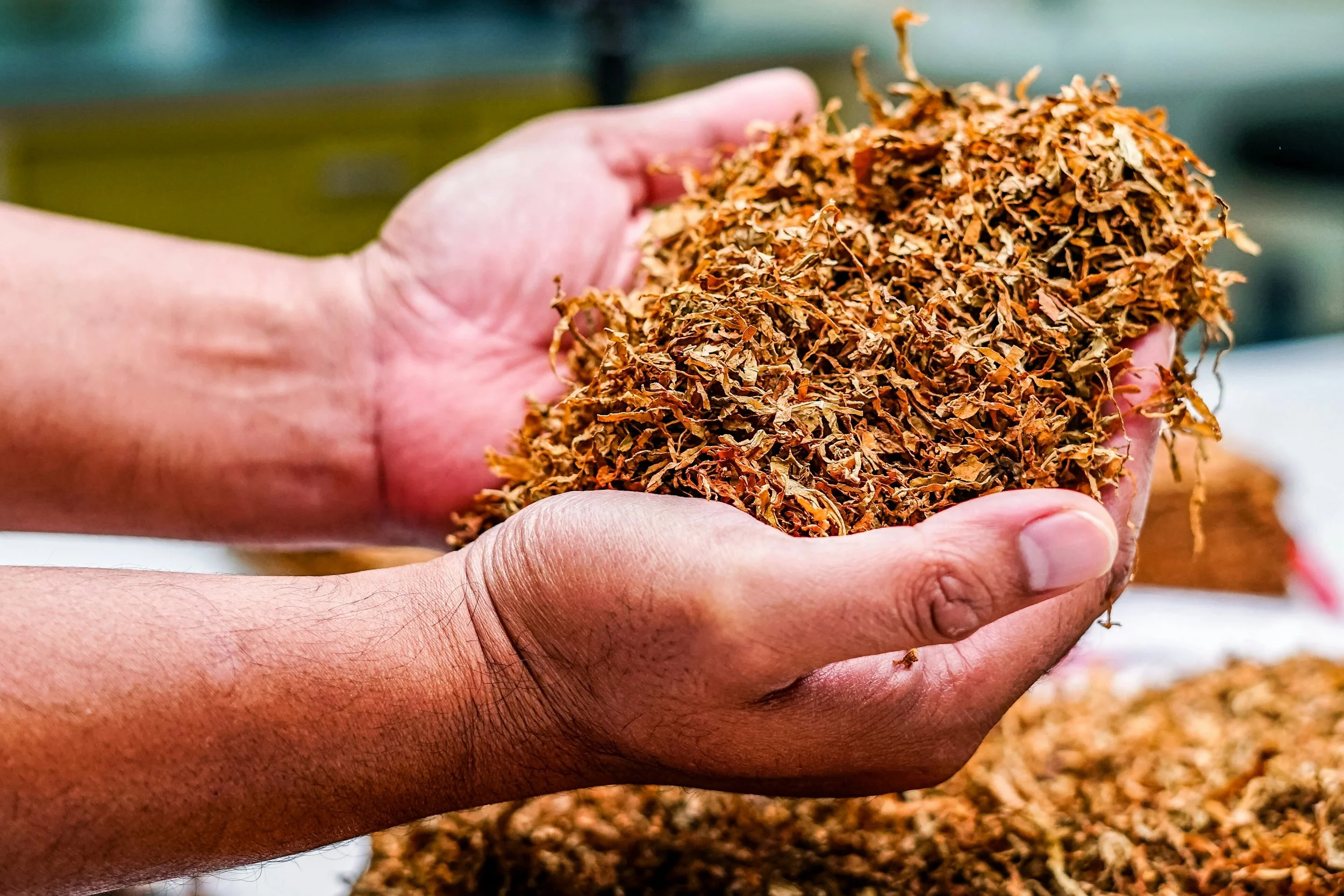
One is a medicine taken in a ceremony. The other is a delivery system for a specific dose of a specific alkaloid, optimised for the market.
In my younger years I had a difficult relationship with tobacco. Cigarettes were bad. They certainly smelled awful. But nevertheless, since the days I would hide behind the tennis courts of my school in Scotland, huddling in the rain and wind to light up, they always had an appeal that went beyond Marlboro man marketing. I could sense, somewhere, buried behind the tar and the chemicals, there was something deeper, something ancient in there that my soul was thirsting for.
I moved to London at a time when Kate Moss was still wandering around with a pack of Marlboro Lights poking out of her skinny jeans. It was still a city of rebels back then and smoking was the name of the game. I had a reasonable habit — five to ten a day — and my lungs hated me for it. That whole decade was a pivot, though, for a lot of people. We came in as Oasis, we left as Coldplay. Gwenyth won. Cocktail bars turned into juice stations and the wellness era was born. Smoking in public was banned, and I became a yoga teacher.
You don't need me to tell you about the dangers of smoking, I'm not your mother. What you might not be aware of, though, is some of the positive uses of tobacco throughout the Americas, where Nicotiana grows.
North America
In most of the northern nations, tobacco sits at the top of the four sacred medicines — alongside sage, sweetgrass, and cedar — and functions less as a drug than as a carrier of intention. It is offered to the Creator, placed on the ground or in water as a gift, and carried in the pipe that opens and closes nearly every ceremony. Among the Anishinaabe it has a name of its own, asemaa, and holds the eastern doorway of the four sacred directions. On the Plains, the pipe was the instrument of prayer, treaty-making, and even the summoning of buffalo; the Pawnee would tamp theirs with an arrow taken from an enemy, folding warfare into the ritual.
Cross into Mesoamerica and the forms multiply. The Maya prepared snuff — tobacco cut with lime — and, in some contexts, administered it rectally for faster absorption. The Huichol go further still: in their cosmology tobacco belongs to the Fire Shaman, and during peyote ceremonies it is used to heal the supernaturals themselves.
South America
If the northern use is ceremonial and contractual, the South American one is more visceral and personal. Tobacco here is not just an offering but a medicine in its own right, and the ways it enters the body — smoked, snuffed, pasted, swallowed, blown — reflect a pharmacology that is as varied as the cultures using it.
The Warao of the Orinoco Delta have no other psychotropic available to their three types of shamans; tobacco is the whole toolkit. The Guajiro of Venezuela take it differently still, consuming it chronically in solid form. Across the lowlands, the act of blowing tobacco powder into the air — the Tacana to repel malevolent entities, the Tukano against supernatural adversaries — is less a ritual gesture than an active defence. The Matsigenka of Peru named their shamans after the plant itself: seripigari, "the one who returns, or is intoxicated, by tobacco." The Huitoto work with ambil, a dense tobacco paste that sits at the centre of their medical practice. The Páez combine chewed tobacco with coca to pull prophetic visions out of dreams, while the Mbya-Guarani call the smoke "life-giving mist."
Rapé — tobacco cut with bark, blown into the nostrils — is perhaps the form most travellers now recognise, used to clear the mind before or after ceremony. But its origins are older and stranger: in lowland initiation rites, novice shamans are fed liquid tobacco through nose and mouth during prolonged fasts, substituting for food and forcing the body into trance. The Yaruro, meanwhile, blow cigar smoke over parties setting out to hunt or gather — a protective gesture that echoes, not coincidentally, the hunting uses of ayahuasca further north.
Mapacho
The plant in a shaman's rapé gourd and the plant in a pack of Marlboros are, in a sense, different animals. Nicotiana rustica — mapacho, wild or Aztec tobacco — carries up to 9% nicotine by dry weight, roughly three to nine times what Nicotiana tabacum puts out (1–3%). It also contains beta-carbolines, the same harmala alkaloids found in ayahuasca's vine, which act as natural MAOIs and are thought to contribute to its entheogenic profile. That combination — high nicotine plus MAO-inhibiting alkaloids — is why it became the backbone of South American shamanic practice: a single pinch of rapé or a few puffs of smoked mapacho delivers a dose that would be lethal if it were in a cigarette, and is dosed accordingly, in small, repeated, ritually framed amounts.
What ends up in a Marlboro is Nicotiana tabacum — almost exclusively burley, with some Virginia and Oriental — blended to hit a lower per-leaf nicotine target, then rebuilt around that base. Ammonia compounds freebase the nicotine, which dramatically increases how much hits the bloodstream per puff and smooths the harshness that would otherwise make the smoke unpleasant. The result is a product designed for chronic, high-frequency use — dozens of cigarettes a day, each delivering a small, predictable nicotine hit — rather than the single, intense, context-bound dose a shaman works with. One is a medicine taken in a ceremony; the other is a delivery system for a specific dose of a specific alkaloid, optimised for the market.
Deep Healing
Over the years I have formed a connection of my own with tobacco and have experience working with the medicine on its own in ceremony and on dieta, in combination with ayahuasca, in rapé form, in alchemical form, and through regular work with mapacho. What I've learned is that he's an intensely strong and protective spirit who can heal at very deep levels.
In my first ayahuasca ceremonies with tobacco I felt him going into my system in a deeper way than I'd ever been able to access with ayahuasca on its own or any other plant. He was able to clear things from ancient times. Patterns lodged deep in my DNA and lineage especially. And that's the irony of it all, the very technology that he holds that can be used to cure disease at the DNA level of our being, is exactly what causes cancer when inverted and used unconsciously in a negative context. He showed me how each negative thought I had when I was smoking cigarettes was being compounded a thousand-fold and locked deep into the structure of who I was. Dislodging that was unbearably tough. I can't tell you how tough in words, but I thought it was going to kill me. He doesn't take any prisoners when it comes to healing. But it's worth it if you can bear it.
Working with Tobacco
Important to say, you need to work with a qualified shaman anytime you go near tobacco. It's a powerful medicine you don't mess around with. And it's still a poison, for sure. Drink or smoke the wrong dose and it will kill you, no question.
Smoking: The most accessible way on your own is by smoking mapachos but I'd even caution against that, not because regular smoking is bad for your health, but because there's just a lot inherently ‘off’ about it. I see a lot of 'medicine' people, Westerners, smoking mapachos like cigarettes and I wince. They're still inhaling. They're actually still hooked and doing what they did with Marlboros hanging out with their friends and calling it spiritual. And they're using a substance designed for prayer and deep healing that still needs to grow, requires good soil and effort from farmers, and so on, in a really casual or unnecessary way. It doesn't sit well with me. But maybe if you can get hold of some and want to use them for a ritual cleansing or something that would work. It is of course up to you.
Drinking: Working with tobacco in liquid form isn't like working with ayahuasca. There aren’t as many visions, no crazy worlds, no enchanting icaros. None of that. Just you, the smoke, and a purge bucket. And believe me you need the bucket. But if you're serious about doing deep healing work, the actual work that will set you free from what's been holding you back, there's nothing quite like working with tobacco for that, as a ceremony or a dieta. Hardly anyone wants to do it though. They’d rather be at the Aya retreat up the road.
Rapé: This is another form that's often really abused. Where people smoke mapachos like cigarettes, they'll blow rapé like cocaine and call it intentional. In most cases, I'm not convinced. It can easily get addictive. I attended one ayahuasca ceremony with a Brazilian tribe and the shaman actually paused the ceremony midway through to deliver a strong message about this. She spoke of the sacredness of tobacco for prayer, and if you keep abusing rapé it won't be there for you when you need it. It was very moving.
The main thing I want to get across is really how little we understand about tobacco. And to take the fizz out of the kombucha around it a bit. Not to encourage you to rush in and start working with it without cultural context or sensitivity because it 'looks cool'. That's just the naughties all over again. But to recognise that here is a medicine, which, if you really need support, can be there for you in a way you won't necessarily enjoy but in a way you could possibly really use.
He has taught me many things over the years and made me a much stronger, clearer person than I otherwise would have been. I'm grateful to him for that. Even if the ride was bumpy as hell. I'm very grateful.