What trauma taught me about holding space.
A few years ago I found myself in a situation that deeply affected me. It wasn’t a car crash or an NDE.
I was in a situation with a teacher I trusted and his community that deeply affected me. It wasn't a single event. It was a pattern, sustained over nearly two years. It was the line ‘the teacher is a perfectly clear mirror’ I believed without question. I developed CPTSD as a result. A wound as old as me torn open and dug into deeper, amplified by ayahuasca work and someone who assumed a position of power and believed he was safe. I went through the messy shamanic, magickal and energetic work to heal myself. It was a steep learning curve.
Bali
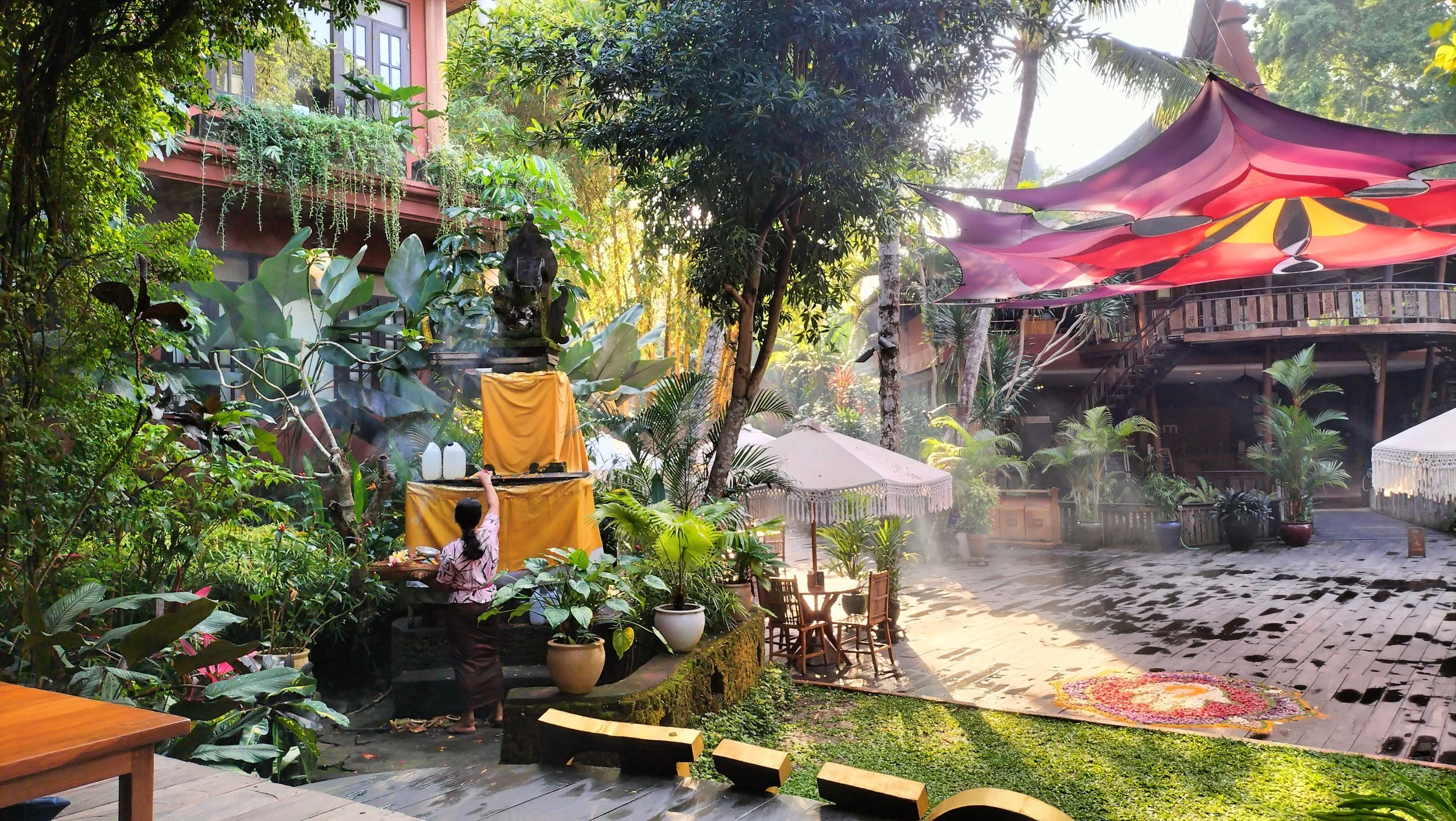
A year or so later I found myself at a large and famous yoga studio complex in Bali. It was time to start reconnecting with my body. They had some excellent healing practitioners, so I saw the craniosacral therapy guy, a wonderful Balinese healer and the osteopath who’s actually so much more than that. All the spiritual travels had been great but a lot of the trauma energy was still stuck. My back was starting to feel it. Here, things began to move. I bought a one-month pass with a view to attending regular classes. In the end, I attended a few but not many. It was enough.
I’ve been to and taught so many thousands of yoga classes in my time and I have many examples of what works and what doesn’t but never with this level of my own personal trauma to negotiate. I’m going to focus on the classes I attended there to illustrate how different styles of holding space can impact someone. It applies to everyone but for people with a dysregulated nervous system it’s of course far more acute.
The Vinyasa Class
First, I attended a vinyasa yoga class. It was exactly the kind of class I had taught twenty times a week back in London. And I hated it. I hated the cool, ambient music. I hated the upbeat ‘vibes’, everyone in their best yoga outfit, ready to follow the command of the teacher and perform the poses. I hated the pace that didn’t let me really stay and feel anything. So I picked a spot at the back of the class, uncomfortable with so many people around me, and I did my own thing – skipping all the vinyasas to have time to actually feel the practice. In a large shala full of obeying soldiers, I was like the dog in the corner.
But aside from all that I’d underestimated the teacher. He wasn’t just another yoga bro. My back was twitchy and I was slow coming out of a back bend. He saw me struggle and he spoke to it. Not in condescending way. In an ‘I”m here with you’ way. He validated where I was and gave me permission to be the sad, unruly old dog I needed to be. And with that, I burst into tears. It was probably the craniosacral as well but that simple act of holding space was the trigger: something finally moved and the floodgates opened. The class ended and I was still crying. An hour later I was still crying. He checked in with me. He made it ok. Casual. No fuss. And once it was done I was resolved that I’d learn how to really be able to do that for others. It’s such a gift.
‘Trauma Yoga’
I’ll contrast it with another class I went to there, not to blame but to reveal. Ironically, it was the trauma yoga class. I was looking forward to it, and set up my mat, bolster, blanket and eye mask in anticipation. Well, it was a ninety minute class, and after that time I left feeling so stressed and spun out it took a day to recover. The teacher clearly had a passion for the work, and had learned a lot of the theory. She’d been through trauma of her own and had come to the work as part of her own healing journey. The trouble was, she’d learned about it, but she hadn’t embodied it. What that looked like in the class was talking the whole way through without a single pause and a whole heap of clever exercises we were invited to feel in our bodies, but given no space to actually do so. And there was something more subtle as well: an energy field that felt frantic rather than grounding. She was ‘trying’ too much and I could feel it dysregulating my own system. I tried to give her some kind feedback after class but she couldn’t hear me. I realised you just have to let people be where they’re at, and if she was coming from a ‘wounded healer’ place right now, so be it. What I needed was a safe, spacious container for somatic experiencing and permission to be broken. What I got was a stressful lecture from someone who was trying to ‘fix’ me.
‘Kriya Yoga’
The third yoga class was called ‘kriya’ yoga but was nothing like the Kriya Yoga I later initiated into in Varanasi. It was led by young woman who played loud hip hop music and deliberately poked at people to make them uncomfortable. It was all about ‘bring up’ your stuff for healing or something. We had to stand in a circle and hold hands and jump around while she blasted the speakers and I lasted about five minutes before the kundalini in my system revolted at the deliberate aggravation and my nervous system said ‘enough’. I told her I needed to take a break. She stood in front of me, face far too close, and said ‘you’re not in your body right now, that’s why’. It landed like an accusation. Oof. I gave it a few breaths without reacting. Then, without a word, I picked up my bag and left. ‘Don’t worry about her, she’s on her own journey’, I heard her tell the class as I left. Yes, I was. A journey of learning what trauma-informed space holding actually looks like. And that wasn’t it.
The Qi Gong Class
A well-groomed male cruises into the shala, oozing effortlessness in well-made, tastefully understated activewear. He’s clearly practiced a lot of the internal martial arts. His presence, posture and movement have a quality of grace and ease you don’t often see in people. I was excited to get to practice qi gong in a class setting again, after a couple of years of doing my own thing and learning online. He starts the class and after the warm up he gives us a sequence to do. I have a question about what your head’s meant to be doing while your body is turning. He dismisses it – you don’t need to know that right now, focus on the basics. Hmm. Ok. We do some more stuff. After a while, I’m a little confused about something again. Qi gong’s a subtle practice and I like to get it right. I decide to risk it, and very politely ask my question.
‘Ok, we’re going to do some different exercises next. I’ve never taught a class where people have asked so many questions. Asking questions is a sign of excess fire in the system. Some people in this class have a lot of excess fire in their systems and they need to be brought back into balance.’ Ouch.
The sad thing is, it wasn’t an unfamiliar type of response. I’ve been shamed for daring to ‘challenge the authority’ of a teacher by asking a simple, innocent and relevant question before. Or heaven forbid for having any form of credibility of my own. I know the ways people who claim to be holding space think that means holding all the status and all the power, and the little humiliation tactics they’ll employ to punish you for being any kind of ‘threat’ to their flawless image. The ways they use the formality of a container to create a power distance and the excuse of holding space as a way of making you subordinate. Whether consciously or unconsciously, it’s a way of getting you to hand over your power. People with normal nervous systems will do it and not really care or think about it. They come out relatively unscathed. Those with CPTSD, however, will slip into fawning or people pleasing behaviour in a heartbeat so as not to feel the discomfort of the situation. They would rather carry the emotional burden themselves to smooth things over rather than have the situation feel awkward. It’s how they learned to survive.
My head was spinning. I sensed there was something off and my system had done enough healing by now not to collapse into fawn. But not yet quite enough to tell him where to go. I noticed the dysregulation as I practiced. Noticed the ‘warning signal’ feeling I was getting. And, as class ended, I knew I would not be back. I felt dismayed. Even a simple qi gong class had turned into a whole thing I had to process.
What this little case study neatly illustrated for me was how holding space for trauma has many components to it and it’s both an art you express and the quality of the presence you embody. No matter how many books you read about it, if you’re not embodying grounded presence, people aren’t going to feel safe around you. There are aspects of being trauma-informed that you can easily apply, such as checking in with someone before your class or ceremony or whatever it is to understand where they’re coming from and giving them instructions on how to navigate aspects that might be triggering for them. Or simply telling them it’s not appropriate. And there are aspects that are harder to apply and take experience – like knowing just what to say, when, and how, to facilitate healing rather than to retraumatise.
But also, no matter how grounded and embodied your presence is, if you haven’t dealt with your own shadow, then you’re making others carry that for you. Someone with complex trauma will unconsciously jump at the chance, as that’s what their nervous system learned all their lives. But if you’re a healer or someone in that space, my guess is, no matter how narcissistic you are, at least a part of you wants to actually help that person and not make things worse. So it’s about recognising the signs of when someone’s trying to compensate on your behalf, and that takes a lot of skill and maturity. If they’re trying too hard to please you, that’s not flattery – that’s the wisdom of their nervous system recognising you as a predator. The teacher is most certainly not a perfectly clear mirror.
I’m still learning this. I’ve had to look at my own patterns, where parts of me still feel threatened and insecure. It’s nuanced and it’s hard. But whether you’ve experienced trauma or not, it’s also a non-negotiable for being in the role of someone holding space. No matter how long you’ve been doing it. The first rule of healing is ‘do no harm’. A lot of healers would do well to remember that.
Want more like this in your inbox? Follow me on Substack or subscribe below.